Shopping for reloading presses for handguns in the USA usually starts with one question: single stage, turret, or progressive? Each press style builds ammunition differently, and the right pick depends on how many rounds you shoot each month, your budget, and how much hands-on control you want over every case.
A weekend shooter loading 200 rounds a month has very different needs than a competitor cycling through 2,000 rounds before a match. This guide breaks down all three press types, the gear that goes with them, and where beginners should realistically start, so you can match your bench to your shooting habits instead of guessing.
A quick snapshot before diving in: single stage presses run roughly 50 to 100 rounds an hour and cost under $250, turret presses climb to 100 to 200 rounds an hour in the $150 to $550 range, and progressive presses push past 200 to 600 rounds an hour once you factor in a case feeder and full accessory kit.
Handgun Reloading Equipment USA Basics: Single Stage and Turret Presses
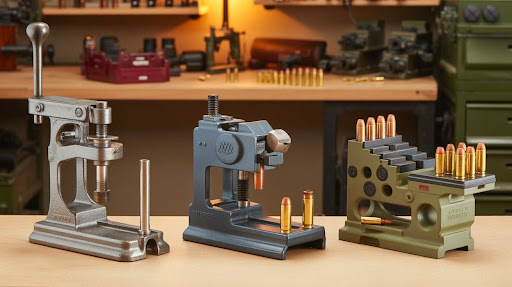
Every setup for handgun reloading equipment in the USA shooters buy begins with a press, and single stage and turret models are the two most common starting points. A single stage press performs one operation per pull of the handle, such as resizing a case or seating a bullet. This forces every case through each die separately, which slows the process but builds strong fundamentals.
Turret presses take that same one-die-at-a-time logic and speed it up by mounting four to six dies on a rotating head, so you switch operations without unscrewing anything between steps.
How a Single Stage Press Handles Each Step
A typical single stage press costs between $80 and $250, making it one of the most affordable ways to learn reloading fundamentals. Because you handle one die at a time, mistakes are easy to catch before they become dangerous.
Most reloaders process 50 to 100 rounds an hour once comfortable with the routine. This slower pace suits precision handgun loads where consistency matters more than speed, which is why bullseye and long-range pistol shooters often keep a single stage press on the bench even after upgrading to something faster.
Where Turret Presses Fit In Between
Output on a turret press rises to roughly 100 to 200 rounds an hour, nearly double a single stage press, since the dies stay mounted and ready. Lee Classic Turret and Redding T-7 are two examples reloaders mention often when moving beyond a basic setup.
Reloading Equipment stocks both single-stage and turret models suited to popular handgun calibers such as 9mm, .45 ACP, and .38 Special, which makes it easier to compare press types side by side before committing to one.
Progressive Reloading Press USA Options for High Volume Shooters
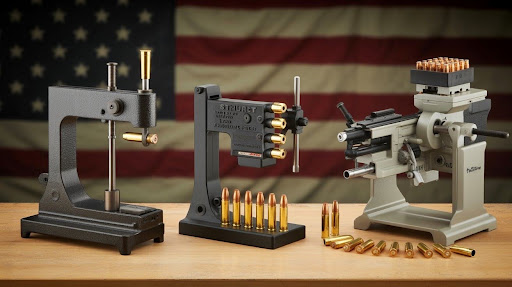
Shooters who load thousands of rounds a month usually graduate to a progressive reloading press in the USA manufacturers built for speed. Progressive presses complete every step- resizing, priming, powder charging, and bullet seating- with a single pull of the handle, producing one finished round per cycle instead of one operation per cycle.
Rounds Per Hour and Why Speed Matters
A progressive press can produce 200 to 600 rounds an hour depending on the model and operator experience. Dillon 550, Hornady Lock-N-Load AP, and Lee Loadmaster are three names that come up often in comparison threads among high-volume pistol shooters.
For shooters comparing reloading presses for handguns in the USA by raw output alone, progressive machines win by a wide margin. The trade-off is a steeper learning curve, since a mistake on one station can affect several cases moving through the press at once.
Who Should Choose a Progressive Setup
Competitive shooters in USPSA, IDPA, or steel challenge matches often burn through 500 or more rounds in a single practice session, which makes progressive loading the practical choice rather than a luxury. Casual range shooters loading a box or two a month rarely need this level of output.
A good rule of thumb: match the press to your actual monthly round count, not the fastest machine on the shelf. Buying more press than you need adds cost and complexity without adding value to your range time.
Adding a case feeder to a progressive setup removes one manual step and can push output closer to the top end of that 600 round figure. Many shooters add this upgrade six months to a year after their first progressive press, once the base process feels second nature.
Handgun Ammunition Reloading Equipment in the USA You Will Need Beyond the Press
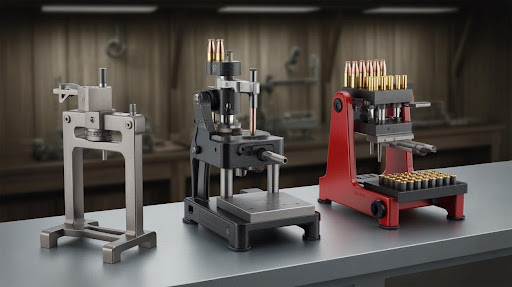
A press is only one part of the picture. Complete handgun ammunition reloading equipment in the USA shoppers need includes dies, a powder scale, calipers, and a case gauge, since none of these tools are optional once you start loading live ammunition.
Dies, Scales, and Case Prep Tools Explained
Standard three-die sets for pistol calibers include a sizing die, an expander die, and a seating die, typically priced from $35 to $90. A digital or beam scale checks powder charges to within 0.1 grains, which matters for consistent pressure and safe performance.
Calipers confirm that overall cartridge length falls within the range published in your load data. Skipping this check is one of the more common ways new reloaders end up with rounds that will not chamber correctly in a semi-automatic pistol.
A case gauge adds a final check before rounds ever reach the range. Dropping each finished cartridge into the gauge takes about two seconds and confirms the overall length and case dimensions sit within factory spec, which matters most in tight-chambered competition pistols.
Matching Components to Your Caliber
9mm, .40 S&W, and .45 ACP each need calibre-specific dies and case gauges, so components rarely cross over between rounds. Retailers such as Reloading Equipment organize kits by caliber, which saves time when outfitting a bench for a specific handgun rather than sourcing each piece separately.
Handgun Reloading Kits for Beginners: Choosing Your First Setup
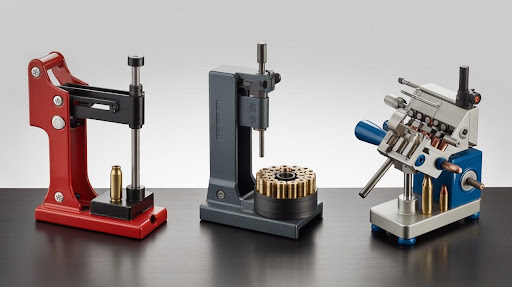
Most new reloaders do better starting with a complete kit rather than buying components piece by piece. Quality handgun reloading kits for beginners in the USA typically bundle a press, a die set, a scale, and a manual in one box, often priced between $300 and $500 depending on the brand and press type included.
What a Beginner Kit Typically Includes
A basic kit usually includes the press, a priming tool, a powder measure, a case lube kit, and a loading manual such as the Lyman or Hornady handbook. Having matched components from day one removes much of the guesswork new reloaders face when building a bench from scratch.
Budget Ranges and What to Expect
Entry kits built around a single stage press run $150 to $350. Turret kit bundles land closer to $350 to $550. Progressive kits start around $500 and climb past $1,000 for fully accessorized setups with case feeders and bullet trays included.
Most reloaders recoup a beginner kit’s cost within the first 1,000 to 1,500 rounds loaded, since factory 9mm ammunition often runs $0.30 to $0.45 a round while reloaded components can bring that closer to $0.12 to $0.18 a round.
Final Thoughts: Matching the Press to Your Shooting Habits
There is no single best answer among reloading presses for handguns in the USA, only the setup that fits your round count, budget, and patience for hands-on work. Single stage presses reward precision, turret presses balance speed and control, and progressive presses serve high-volume shooters who value output above all else.
Start with an honest look at how many rounds you actually load each month, then choose accordingly. Retailers like Reloading Equipment carry all three press types along with the dies, scales, and kits needed to build a complete bench from day one, whether you are loading your first 50 rounds or your five thousandth.
| Ready to Build Your Reloading Bench?
Shop single stage, turret, and progressive presses, plus dies, scales, and beginner kits, all in one place. |
Frequently Asked Questions
Q1: What is the best press for a first-time handgun reloader?
A: A single stage press is the easiest way to learn the fundamentals safely.
Q2: How fast is a progressive reloading press?
A: Progressive presses can produce roughly 200 to 600 rounds an hour.
Q3: Do turret presses cost more than single stage presses?
A: Turret presses typically cost $50 to $150 more than comparable single stage models.
Q4: What is included in most beginner reloading kits?
A: Most kits bundle a press, a die set, a scale, and a loading manual.
Q5: Can one reloader use more than one press type?
A: Yes, many reloaders keep a single stage press for precision alongside a progressive press for volume.